
- Published on
BIM Manager vs Coordinator vs Modeller: What's the Difference?
BIM adoption is rising globally. Infrastructure mandates are growing, regulatory requirements like CORENET X are becoming law, and complex projects — data centres, hospitals, airports — demand rigorous digital coordination.
But here's the reality: most BIM implementations fail not because of bad software, but because of the wrong team structure.
The "People-Process-Technology" framework is well-known in digital transformation circles. Technology is usually the easiest part to get right. People and process — that's where most projects fall short.
In this article, we break down the three core roles in a BIM team, what each one actually does, and how to structure your team based on your role in the project.
The Three Core BIM Roles
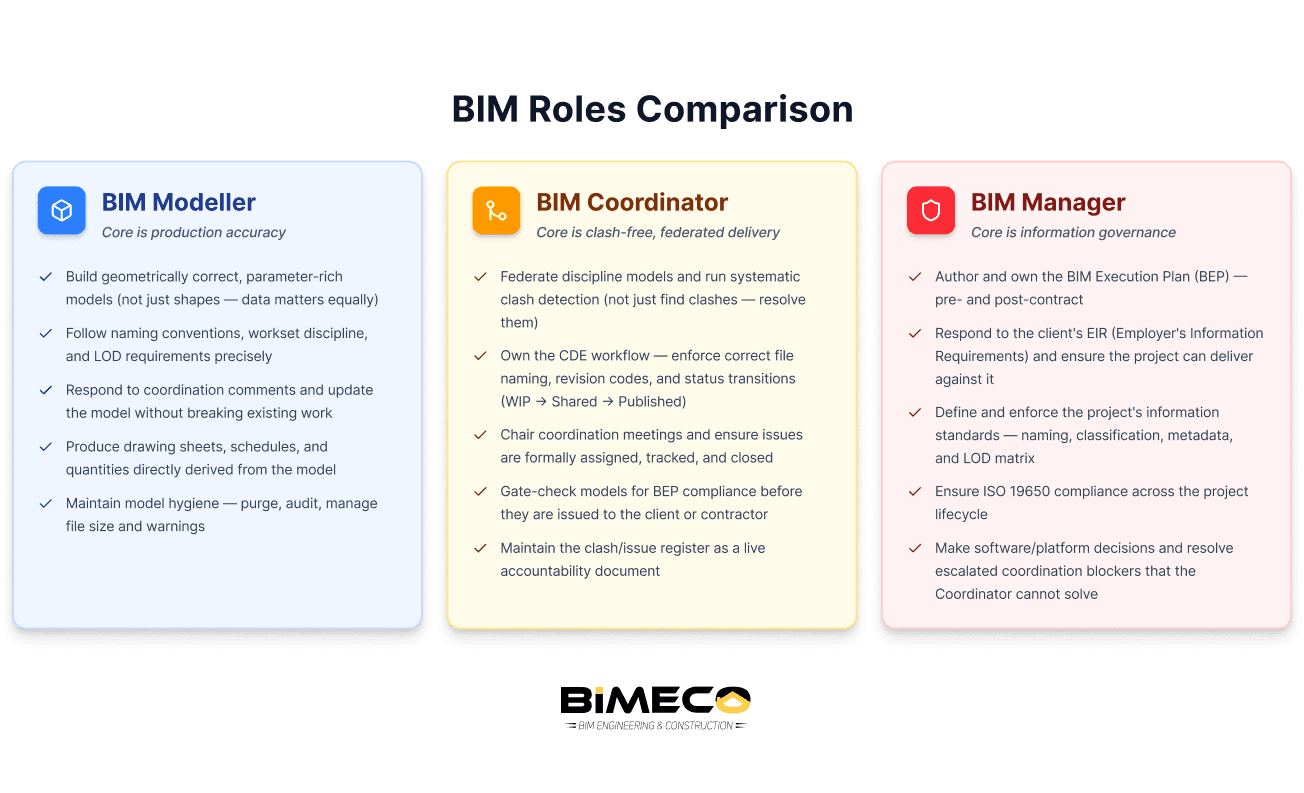
A well-structured BIM team typically operates across three tiers: strategic direction, project execution, and model development. Each role has a distinct focus and accountability.
BIM Manager: Model Governance
The BIM Manager's core is information governance. They operate at the project level, not the model level.
Key responsibilities:
- Author and own the BIM Execution Plan (BEP) — pre- and post-contract
- Respond to the client's EIR (Employer's Information Requirements) and ensure the project can deliver against it
- Define and enforce the project's information standards — naming conventions, classification systems, metadata requirements, and LOD matrix
- Ensure ISO 19650 compliance across the project lifecycle
- Make software and platform decisions
- Resolve escalated coordination blockers that the Coordinator cannot solve
A BIM Manager who only knows how to model is not a BIM Manager. The role is fundamentally about setting standards that others can execute against — and ensuring those standards hold throughout the project.
BIM Coordinator: Ensuring Execution Success
The BIM Coordinator's core is clash-free federated delivery. They sit between the Manager's strategy and the Modellers' output.
Key responsibilities:
- Federate discipline models and run systematic clash detection: not just find clashes, but resolve them
- Own the CDE workflow: enforce correct file naming, revision codes, and status transitions (WIP → Shared → Published)
- Chair coordination meetings and ensure issues are formally assigned, tracked, and closed
- Gate-check models for BEP compliance before they are issued to the client or contractor
- Maintain the clash/issue register as a live accountability document
The Coordinator is the person who makes sure that what the Manager designed on paper actually happens in practice. If models are going out with wrong naming, unresolved clashes, or missing data — that's a coordination failure.
BIM Modeller: Model Development and Data Input
The BIM Modeller's core is production accuracy. They build and maintain the actual BIM models.
Key responsibilities:
- Build geometrically correct, parameter-rich models. Not just shapes; data matters equally.
- Follow naming conventions, workset discipline, and LOD requirements precisely
- Respond to coordination comments and update the model without breaking existing work
- Produce drawing sheets, schedules, and quantities directly derived from the model
- Maintain model hygiene — purge, audit, manage file size and warnings
A good Modeller doesn't just know how to draw in Revit. They understand why model discipline matters — and they can update a complex model under coordination pressure without introducing errors.
How Team Composition Depends on Your Project Role
The right team structure depends on where you sit in the project hierarchy.
As a Consultant or General Contractor
If you're running the design or leading the main contract, you likely need all three roles — at least in some form.
A BIM Manager should be engaged from the start. Before a single model is opened, someone needs to set the overall strategy for BIM implementation: define the standards, respond to the client's EIR, and set up the CDE correctly. Getting this wrong at the start creates expensive rework later.
Once strategy is in place, a BIM Coordinator oversees the team of Modellers — running QA/QC on submitted models, enforcing naming conventions, flagging issues, and managing the federated coordination model. For larger projects with multiple disciplines, you may need more than one Coordinator.
As a Trade Contractor
Most trade contractors work with a single BIM Modeller, or a small team, to develop their trade scope for submission to the main contractor.
This is where we see the most common mistakes. Trade contractors often engage inexperienced modellers to keep costs down — and end up with models that don't meet the data quality standards mandated in the project. The result: models get rejected, rework is required, and deadlines slip.
If your models are consistently getting rejected, that's not just a modelling problem — it's a quality control problem. At minimum, you need someone who can check the models against the BEP requirements before submission.
Smaller Projects
Not every project needs three dedicated people. On smaller projects, one experienced person may take on the Manager and Coordinator roles simultaneously, while a Modeller handles production. What matters is that the responsibilities are clearly owned — not that you have three job titles.
What Happens When Roles Are Missing or Confused
The clearest sign of a broken BIM team structure is when everyone is "doing BIM" but no one is accountable for quality.
- No BIM Manager: Models get developed without clear standards. Every discipline does things differently. Clash detection is run but the underlying data is inconsistent, making downstream use for CORENET X submissions or facilities management nearly impossible.
- No BIM Coordinator: Models pile up without systematic review. Coordination meetings happen but issues aren't tracked. The same clashes reappear in successive model revisions.
- Undertrained Modellers: Geometrically acceptable models with incorrect or missing data. Naming conventions are wrong. File sizes balloon. Drawing generation requires manual work.
Each failure mode is different, but the root cause is the same: unclear ownership of BIM responsibilities.
How Bimeco Can Support Your Team
We provide BIM expertise across all three tiers, depending on what your project needs.
Project Initiation: Engage our BIM Managers to set the overall strategy for BIM implementation — authoring the BEP, responding to your client's EIR, defining naming conventions and LOD requirements, and setting up the CDE correctly from day one.
Execution: Work with our BIM Coordinators to manage complex multi-discipline coordination, enforce data quality standards, and keep your project on timeline. We handle clash detection workflows, issue tracking, and model gate-checks before submission.
Modelling: Our BIM Modellers develop compliant models from PDF, CAD, tender documentation, and internal design standards — across architecture, structure, and MEP disciplines.
Whether you need to plug a specific gap or build out a full BIM team for a project, drop us a message and we can work out the right structure for your scope.
Frequently Asked Questions

Related Articles
BIM Implementation in Singapore: A Practical Guide for Subcontractors
A practical guide for MEP subcontractors adopting BIM in Singapore. Learn workflows, costs, and CORENET X requirements for 2026 compliance.
Free Tools for CORENET X Compliance: Bimeco Validator Features
Free web-based tool for CORENET X BIM submissions in Singapore. Validate & edit IFC+SG models, handle 5GB files, bulk editing—all free. See key features.
CORENET X BIM Submission Tool: The Bimeco Validator
Need to validate and update your BIM models for CORENETX submission? The Bimeco Validator helps users validate and update their model files for CORENET X compliance.