- Published on
Is BIM Submission Mandatory Under CORENET X?
Key Takeaways
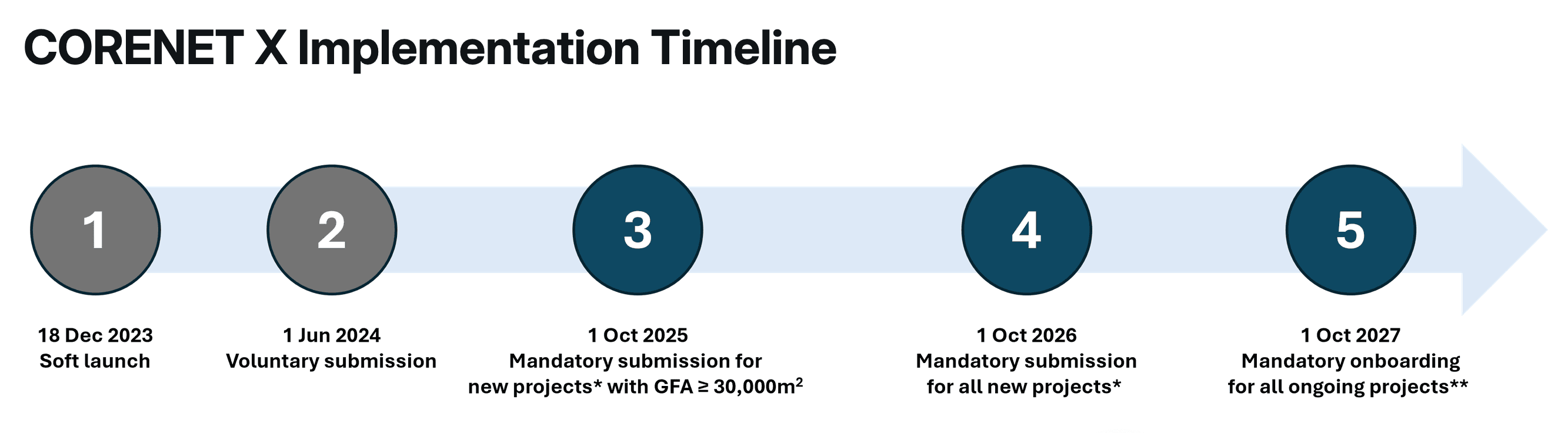
- From 1 October 2026, the Qualified Person submits BIM models through CORENET X (CX); this is not optional
- Sub-consultants are not direct submitters, but their discipline models feed the federated submission; if your IFC+SG data fails, it may affect the CX Submission
- Multiple written submissions risk resubmission fees that can reach 5 figures and delay project permits
- Validate each discipline model against IFC+SG requirements before it reaches the lead consultant
If you're a consultant on a Singapore building project, the shift to mandatory Building Information Modelling (BIM) submissions under CORENET X (CX) raises an important question: is this your problem to solve, or is the lead consultant responsible?
From 1 October 2026, BIM submissions will become mandatory for a broad range of building works in Singapore. The CORENET X Code of Practice establishes clear responsibilities across the entire project team, guiding through the Three Gateways of Design, Piling, and Construction.
In reality, each consultant involved in the project has a responsibility to ensure their models comply with CX data requirements. Your model data ultimately feeds into the federated BIM model managed by the lead consultant. Smaller errors in downstream models can accumulate and surface at the point of submission - the point at which project teams can least afford to make changes.
Understanding where your obligations begin and end is the essential first step. Taking steps to ensure you meet CX submission requirements is the logical next step.
BIM Submissions Are Mandatory
Yes, most consultants do need to contribute BIM models under CORENET X, but the lead consultant (also known as the Project Coordinator) carries the primary submission responsibility. Sub-consultants aren't off the hook, though. What's actually required of you depends on your discipline, your project scope, and how your team has structured the federated model.
The submission framework operates on a collaborative model: the lead consultant aggregates and submits, while each discipline consultant is accountable for producing a compliant, coordinated model that feeds into that submission. Producing a non-compliant model or missing required parameters creates downstream problems for the entire submission chain.
Some things to look out for include:
- No Clash - The federated model must be free of physical conflicts between disciplines. A duct running through a structural beam or a pipe clashing with a cable tray will flag during automated checks and stall the submission.
- IFC+SG Data - Each discipline model must include the correct IFC+SG property sets for its scope. Missing parameters like
SGPset_SlaborSGPset_PipeSegmentTypeare a common reason for rejection, even when the geometry looks correct. - Code of Practice Compliance - Models must meet the requirements set out in the CORENET X Code of Practice, including the correct Level of Detail and data inputs at each Gateway stage (Design, Construction, Completion).
Mandatory BIM submissions will apply to projects from 1 October 2026, as confirmed in the BCA's circular on CORENET X. For sub-consultants, the practical implication is clear: your deliverable must meet Industry Foundation Classes (IFC)+SG standards before it reaches the lead. Understanding what those requirements look like is no longer optional.
Roles and Responsibilities

Under the CORENET X Code of Practice, projects operate through a federated BIM model: a coordinated assembly of discipline-specific models rather than one monolithic file. The Project Coordinator (typically the architect or lead consultant) owns the federated model and bears primary submission accountability. However, structural, M&E, and other specialist consultants each play an important role in contributing discipline models that feed into it.
This responsibility cannot be deferred to the Project Coordinator, because the BIM models contain essential information that can only be best understood by the responsible consultant. For example, SGPset_Pump requires input for the volumetric flow rate. This information can only be best understood by the Piping and Instrumentation Diagram (P&ID) engineer, and is not captured by the Architect.
In practice, each contributor produces an IFC+SG-compliant model for their respective scope across the Three Gateways Submissions: Design, Construction, and Completion. Those models are then coordinated and submitted through the Project Coordinator.
Practitioner Note: Tools like the Bimeco Validator are designed for Singapore-based BIM validation that will pass CORENET X checks.
What is IFC+SG for CORENET X?
IFC+SG is Singapore's extension of the global IFC4 standard, adding the data parameters that regulatory agencies like BCA, PUB, and NEA require to issue planning or permit approvals. This is where most consultants stumble. Even when a model is geometrically clean and well-coordinated, missing or incorrectly assigned IFC+SG parameters can trigger submission failures that delay the entire project team.
For structural engineers, a frequent issue is the IfcSlab entity. The geometry exports correctly, but the mandatory SGPset_Slab property set is often missing or incorrectly mapped. Fields like ConstructionMethod require precise values such as CIS, PC, or PT (Pre). The physical slab transfers seamlessly, but the regulatory data does not.
For M&E consultants, a common pitfall is the misalignment of IfcDuctSegment or IfcPipeSegment parameters with PUB or NEA requirements. These elements often lack property sets like SGPset_DuctSegmentType or SGPset_PipeSegmentType, which are required for regulatory compliance.
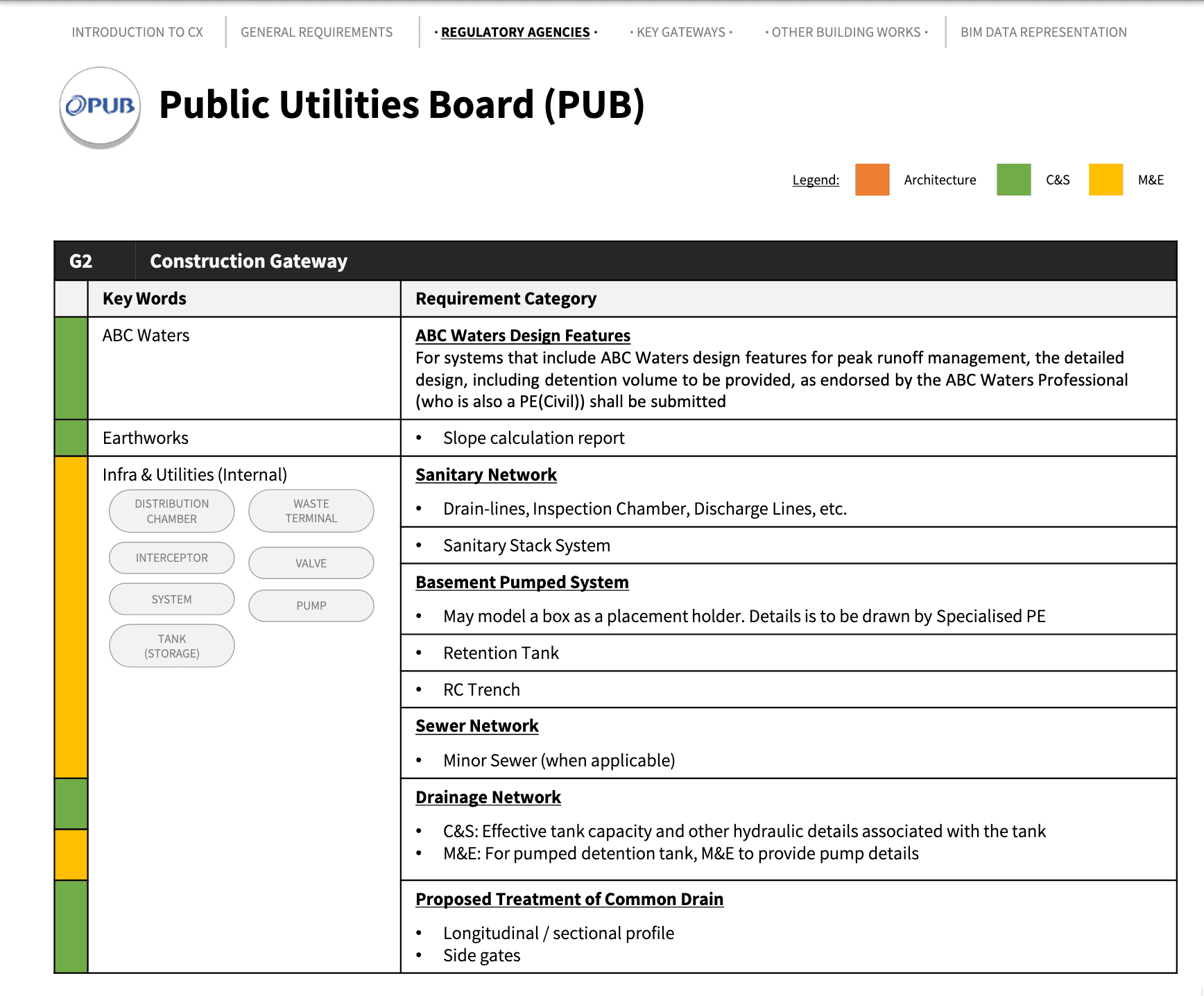
The practical safeguard is validating each discipline model against IFC+SG requirements before it reaches the lead consultant. This starts with ensuring your BIM authoring tool (e.g. Revit, ArchiCAD) is configured to include the CX property sets expected by regulatory agencies. Tools that support CORENET X submission validation can flag parameter gaps long before a formal submission attempt.
Practitioner Note: Property sets prefixed with
SGPset_are Singapore-specific and will not exist in standard IFC templates. If your exported model is missing these fields, your authoring tool likely needs the IFC+SG mapping configured before export.
The Cost of a Failed Submission
When data is not structured in the format expected by CORENET X, it triggers the risk of a Written Direction. Multiple written directions may require having to re-apply for a CX submission, incurring resubmission fees that can rise to 5 figures.
More critically, a failed submission will inevitably impact project schedules, as the necessary permits to begin work are delayed. This can increase project costs as more time is required by each consultant to prepare for a new submission.
Some quick fixes include: IFC+SG training for internal BIM teams, proper tools setup, and the use of CORENET X validators that ensure data is structured for submission success.
Most validators on the market only check for data completeness. They do not verify the correctness of design inputs. These remain under the purview of the engineer or Qualified Person (QP).
BIM Submissions are more than 3D
A BIM model can look complete in 3D and still fail submission. The geometry might be fine, but the underlying data is where rejections happen - missing property sets, wrong parameter values, or clashes that only surface during automated checks. Most internal BIM teams are trained to model, not to navigate Singapore's regulatory data requirements.
Most consultants run lean BIM teams that juggle modeling with core engineering work. That works until multiple projects hit submission deadlines at the same time. When that happens, you either push through with existing staff or bring in outside help.
Keeping it in-house means your team already knows the project, but the same engineers doing design work are now also debugging IFC+SG compliance under deadline pressure. Mistakes made at this stage usually only show up after the QP has already reviewed the package.
Bringing in BIM coordinators or submission specialists offloads the work, but they need time to get up to speed on your project standards and handoff expectations.
A rough guide: if your BIM team is already at 80% capacity when the submission window opens, outside support is the safer bet. Either way, you still need to validate models before they go to the lead consultant. That is what tools like the Bimeco Validator are built for.
Preparing for CORENET X
Given the mandatory submission requirements, it is important to get ready. For firms with established BIM teams, attending IFC+SG Training Courses is an essential part of ensuring internal BIM teams understand the submission workflow and implications of a failed submission. BCA also releases helpful software-specific resources that help consultants meet CX submission requirements. You can also use the Bimeco Validator to check your models against IFC+SG requirements before submission.
For consultants that need to scale BIM teams quickly, or don't wish to grow this capability internally in the near term, working with Managed BIM Services firms can help you meet tight submission deadlines. Working with skilled BIM consultants that set up BEPs from day one and have an extensive BIM network will help you improve the odds of an on-time successful submission.
Frequently Asked Questions

Related Articles
BIM Execution Plan Template for Singapore Projects: Free Download (CORENET X Ready)
Download a free BIM Execution Plan template built for Singapore projects. 32-page PDF covering CORENET X workflow, IFC+SG, clash detection, ISO 19650 CDE, and LOD progression.
What Does a BIM Consultant Do for an Architect or Engineer in Singapore? (2025)
Full scope of a BIM consultant on architect and engineering consultant projects in Singapore — covering EIR authoring, Design Gateway CORENET X, clash coordination at design stage, and handover strategy.
What Does a BIM Consultant Do for a Main Contractor in Singapore? (2025)
Full scope of a BIM consultant on Singapore main contractor projects — covering BEP, clash detection, CORENET X, 4D/5D/6D BIM, and as-built handover.