
- Published on
Faster Permits, Fewer Reviewers: The Case for Model-Based Permitting
Key Takeaways
- U.S. building departments are losing 21%+ staff while permit demand grows; hiring more reviewers is not a viable fix
- Model-based permitting submits the BIM model itself, not flat PDFs, so software can automate measurable code checks before a reviewer touches the file
- Singapore and Norway already run this at national scale; U.S. cities like San Jose are piloting AI-assisted permitting
- No automated checker issues a permit; credentialed reviewers still apply judgment on exceptions and interpretation
- Cities can start with one agency and one permit type, then expand incrementally across agencies and into automated rule checking
U.S. building departments are losing staff, watching senior reviewers retire, and struggling to keep up with growing infrastructure demand. Slow permit turnaround holds up construction timelines and prevents the U.S. from capturing the full benefits of foreign direct investment on the economy.
Model-based permitting, where applicants submit a BIM model instead of flat PDFs, offers a way to scale review capacity without a corresponding increase in headcount.
Growing Pains
Three pressures are converging on municipal building departments, and none of them are easing in the next decade.
Poor Staffing
New York City's Department of Buildings has lost more than 21 percent of its construction-related staff since 2021. Plan examiners, project managers, and inspectors are all below pre-pandemic levels.
NYC is not an outlier. State and local governments collectively shed roughly 305,000 jobs since February 2020, and building departments are competing with the private sector for the same shrinking pool of credentialed professionals.
Worker Attrition
The construction sector overall is facing roughly 41 percent of its workforce retiring by 2031. In a recent International Code Council (ICC) survey, more than 70 percent of planning professionals cited staffing shortfalls as a barrier to meeting mandated permitting deadlines.
Senior reviewers carry decades of accumulated code interpretation in their heads. When they retire, that knowledge leaves with them.
Rising Infrastructure Demand
Federal and state housing goals have made permit cycle time a political variable. Cycle time in U.S. cities currently varies by an order of magnitude. Fast-track suburban jurisdictions issue permits in two to four weeks, while major California and Texas central cities routinely run eight to sixteen weeks for a first review, with two or three review cycles before approval.
Every week shaved off that median is a datacenter, manufacturing plant, or fab that starts operating sooner, letting foreign investors capture returns faster and local economies capture jobs faster.
A Perennial Problem
Hiring more reviewers does not work when the workforce is not there to hire. Cities posting plan examiner jobs are recruiting from the same shrinking talent pool, often poaching from each other rather than expanding the total.
Moving from paper to PDF has improved filing and tracking, but not the review itself. The reviewer still opens a PDF and checks it manually. ePermitting modernized the inbox; it did not modernize the work.
Code rewrites take years to trickle down through professional training, design tooling, and inspection practice. The industry is already chasing a fast-moving regulatory horizon, from energy and accessibility to the periodic IBC (International Building Code) / IRC (International Residential Code) cycle that drags every dependent municipality along with it.
What Model-Based Permitting Actually Is
Model-based permitting means submitting and reviewing the building model itself, not 2D representations of it.
In a traditional permit workflow, an architect or engineer prepares drawings, exports them to PDF, and uploads them to an e-permitting portal. Reviewers open each PDF and check it manually: measuring egress widths, tracing accessible paths, comparing fixture counts to occupancy. The BIM (Building Information Modeling) model the design team built is left behind in their software. The city only ever sees flat outputs.
In model-based permitting, the design team submits the BIM file directly, typically in IFC (Industry Foundation Classes) format, an open standard maintained by buildingSMART. Software runs automated checks against measurable code provisions before a reviewer is ever assigned:
- Dimensional rules: egress widths, setbacks, accessibility clearances
- Counts: fixtures, exits, parking spaces
- Consistency: do the structural, mechanical, and architectural models align?
The reviewer's queue starts with a pre-flagged model and a written report of what the automation could verify, what it could not, and what needs human judgment.
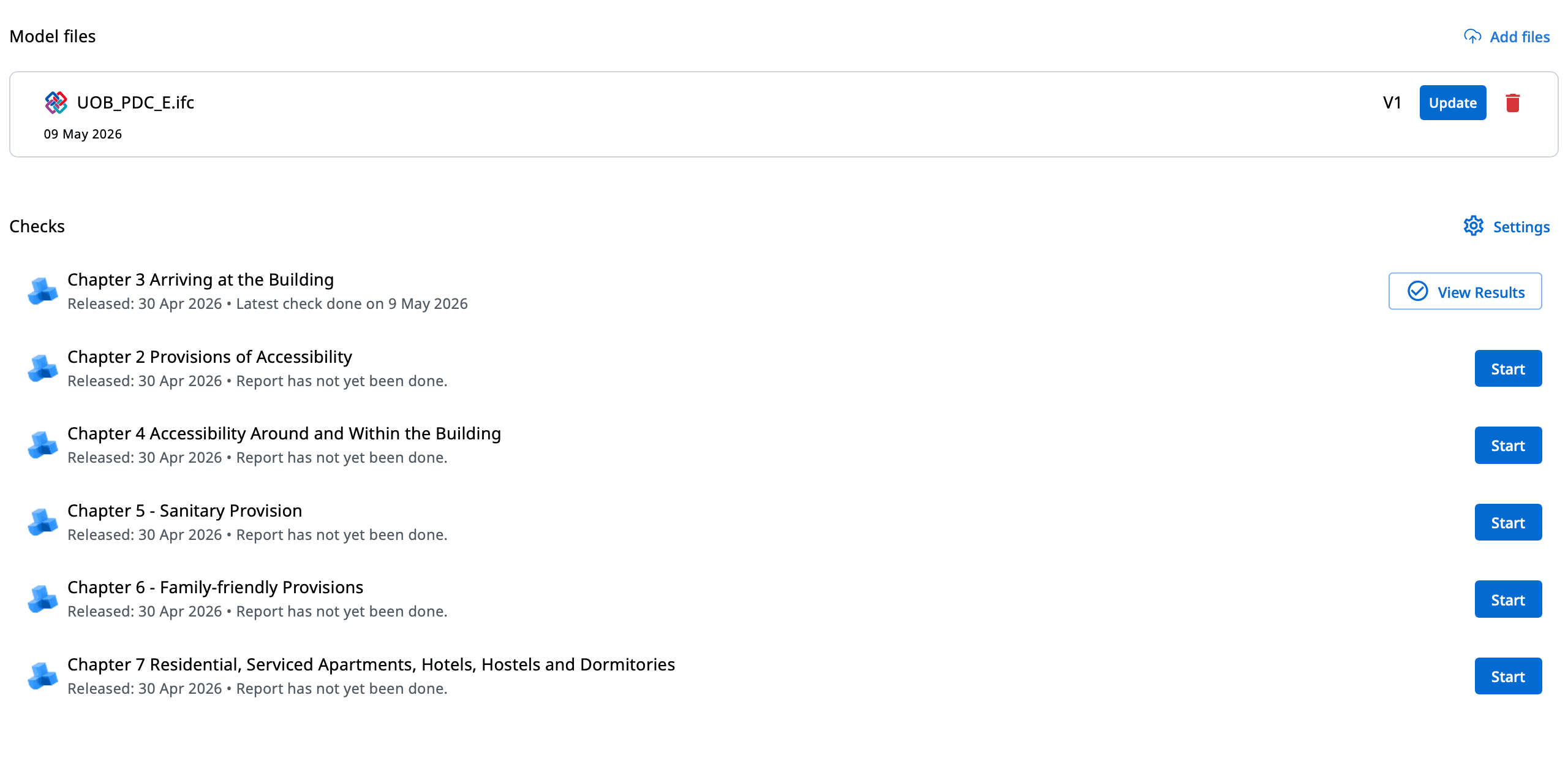
Tools in this category, including Solibri's intelligent model checking, can be configured to run jurisdiction-specific rule libraries against geometry, clearance, accessibility, fire safety, and information completeness.
Permit Modernization Examples
There is a strong case for model-based permitting, with at least two countries already running such a system in production at national scale.
Singapore: CORENET X
In December 2023, Singapore's Building and Construction Authority (BCA) soft-launched CORENET X, a system that consolidates more than 20 separate approval touchpoints across five government agencies into three key gateways, with a target turnaround of 20 working days.
Mandatory submission via CORENET X for new projects of 30,000 m² gross floor area or more began on 1 October 2025. All in-flight projects must onboard by October 2027.
Norway: ByggSøk
The Norwegian Building Authority (DiBK) operates ByggSøk, the national portal for electronic building permit submission. Norway has invested in BIM-based public submission infrastructure for more than a decade. Academic comparisons of public-sector model-checking solutions routinely group Norway with Singapore as the two most advanced jurisdictions.
United States: Growing Momentum
There is growing awareness of the need for permit modernization in the U.S. San Jose's Planning, Building and Code Enforcement Department launched an AI-assisted permitting pilot in fall 2025, and HUD's Pathways to Removing Obstacles to Housing (PRO Housing) program has awarded approximately $185 million across two rounds for permit modernization efforts, with Detroit receiving $4.2 million and Sacramento County roughly $2.7 million. Singapore and Norway offer two proven models for the U.S. to build on.
Standards Alignment
A model-based permitting platform is generic. The rule library it runs against is not.
Each jurisdiction's codes are encoded as machine-readable checks across local rules for zoning, energy, accessibility, and fire safety. Singapore's CORENET runs against Singapore's code. Norway's ByggSøk runs against Norwegian code. A pilot in Sacramento would run against the California Building Standards Code with Sacramento's local amendments layered on top.
When a building code changes, the rule library can be updated once and every subsequent submission checked against the new rule automatically. Encoded codes would also be auditable: a city could trace exactly which rule was applied to a permit issued in a given year.
Human in the Loop
No automated checker issues a permit. The platform produces a structured report of what passed, what failed, and what was ambiguous. A credentialed reviewer applies professional judgment on exceptions and any provision that requires interpretation.
A Three-Phase Rollout
No city needs to go from PDF review to full automation in one step. The practical path is incremental: three phases, each standing on its own, each enabling the next.
Phase 1: Structured Submission, Single Agency
Start with one agency and one permit type. Define what data must be included in the BIM submission and in what format. Build the intake pipeline: submission portal, validation, and hand-off to reviewers. Reviewers work with the model directly. Code compliance is still a manual judgment call, but now made on a structured model instead of a flat PDF.
Phase 2: Multi-Agency Submission, Shared Data Standards
The same model serves multiple agencies. Building, planning, fire, environmental, and transportation each extract the data they need from a single submission, without requiring the applicant to file the same project four different ways. This is the architecture Singapore's CORENET X built: more than 20 approval touchpoints consolidated into three multi-agency gateways.
Phase 3: Automated Code Compliance
With structured data flowing across agencies, automated rule checking becomes viable. Tools like Solibri already do this on properly structured models: accessibility checks, dimensional rule verification, clearance and clash detection, all applied automatically before a reviewer opens the file. This is where reviewer time shifts from measuring the obvious to applying human judgment to more complex scenarios. An audit trail of issue resolutions is created, tracking metrics like time to resolution and time since an issue is first surfaced.
Getting Started
Model-based permitting does not require replacing existing systems overnight. 2D drawings still capture details that are not immediately evident in a 3D model, and early implementations should accommodate both formats through open interfaces and APIs.
The lowest-hanging fruit is a standardized data schema: one that lets multiple agencies extract the information specific to their domain from a single submission. The immediate gain is reducing back-and-forth between agencies and applicants.
The building departments that start now, even with a single permit type and a single agency, will be the ones with working infrastructure when the workforce pressure gets worse. The technology exists. The funding exists. The question is which jurisdictions move first.
Frequently Asked Questions

Related Articles
Is BIM Submission Mandatory Under CORENET X?
BIM submissions are mandatory for QPs from October 2026, but sub-consultants carry indirect obligations. Here is what each discipline actually needs to do.
Beyond 3D Models: Why Strategic BIM Services Are the Key to Construction ROI
Strategic BIM services deliver 8-10x ROI through clash detection, 4D scheduling, and 5D cost control. Learn how to move beyond 3D models.
BIM Level of Development (LOD): LOD 100 to 500 Explained
A practical breakdown of BIM LOD stages from 100, 200, 300, 350, 400, and 500, explaining how each level of development evolves from design to construction and project handover.