- Published on
Digital Twin Solutions in Singapore: Benefits, Costs & Implementation
Singapore's push toward becoming a Smart Nation has accelerated the adoption of digital technologies across all sectors. For facility managers, asset owners, and developers, digital twins represent a significant opportunity to improve operational efficiency, reduce costs, and meet increasingly stringent sustainability requirements. But what does it actually cost to implement a digital twin? How long does it take? And what kind of return can you expect?
This guide provides concrete answers to these questions, with pricing breakdowns, realistic timelines, and practical considerations specific to the Singapore market.
What is a Digital Twin?
A digital twin is a virtual replica of a physical asset that's continuously updated with real-time data from IoT sensors and building systems. Unlike a static BIM model, which represents the design and structure of a facility, a digital twin mirrors the actual operational state of the building—tracking temperature, humidity, energy consumption, equipment performance, and more.
Think of it this way: if a BIM model is like a detailed architectural blueprint, a digital twin is like having a live video feed with data overlays showing exactly what's happening inside your building at any moment. This live connection enables predictive maintenance, energy optimization, and data-driven decision-making throughout the asset lifecycle.
For a deeper dive into digital twin concepts and benefits, see our comprehensive guide on BIM digital twins.
Why Singapore Companies are Adopting Digital Twins
Smart Nation initiatives and government support
The Singapore government has made digital transformation a national priority. The Building and Construction Authority (BCA) is actively promoting digital construction technologies, including digital twins, as part of its push toward a more productive and sustainable built environment.
Green Mark requirements are becoming increasingly stringent, with building owners required to demonstrate measurable improvements in energy efficiency and sustainability performance. Digital twins provide the monitoring and analytics capabilities needed to meet these requirements and generate the documentation for compliance reporting.
The government's Integrated Digital Delivery (IDD) framework also emphasizes the importance of structured data and digital collaboration throughout the project lifecycle—foundations that make digital twin implementation more straightforward.
Local industry drivers
Singapore's unique market conditions create strong incentives for digital twin adoption:
High land costs mean every square meter must be optimized. Digital twins help facility managers maximize space utilization, reduce energy waste, and extend asset lifecycles—directly impacting the bottom line.
Aging infrastructure across both public and private sectors requires more sophisticated maintenance strategies. Predictive maintenance enabled by digital twins can reduce equipment failures by 20-40%, a critical advantage for facilities that can't afford downtime.
Data center growth is exploding in Singapore, driven by the region's digital economy. These facilities have strict uptime requirements (99.67%+ for Tier 1 centers) and energy efficiency mandates. Digital twins are becoming essential for managing these complex facilities.
Healthcare facility requirements for environmental monitoring are particularly stringent. Operating rooms must maintain 15-20 air changes per hour, and humidity levels must stay within tight ranges. Digital twins automate this monitoring, reducing manual checks and ensuring compliance.
Digital Twin Implementation Costs in Singapore
Let's break down the actual costs you'll encounter when implementing a digital twin in Singapore. These figures are based on real projects and current market rates.
Initial Setup Costs
BIM model creation: If you don't have an existing BIM model, you'll need one as the foundation for your digital twin. For existing buildings, this typically involves laser scanning followed by BIM model development. Budget approximately $20,000 SGD for a standard facility. This process, known as scan to BIM, creates an accurate as-built model that serves as the visual backbone of your digital twin.
IoT sensor deployment: Costs vary significantly based on the number and type of sensors required. Temperature and humidity sensors start around $50-200 each, while more sophisticated sensors for equipment monitoring can run $500-2,000. A typical medium-sized facility might require 50-200 sensors, plus gateway devices ($300-1,000 each) to connect them to your network. Plan for $10,000-50,000 depending on building complexity.
Software platform licenses: This is where you'll need to evaluate your options carefully:
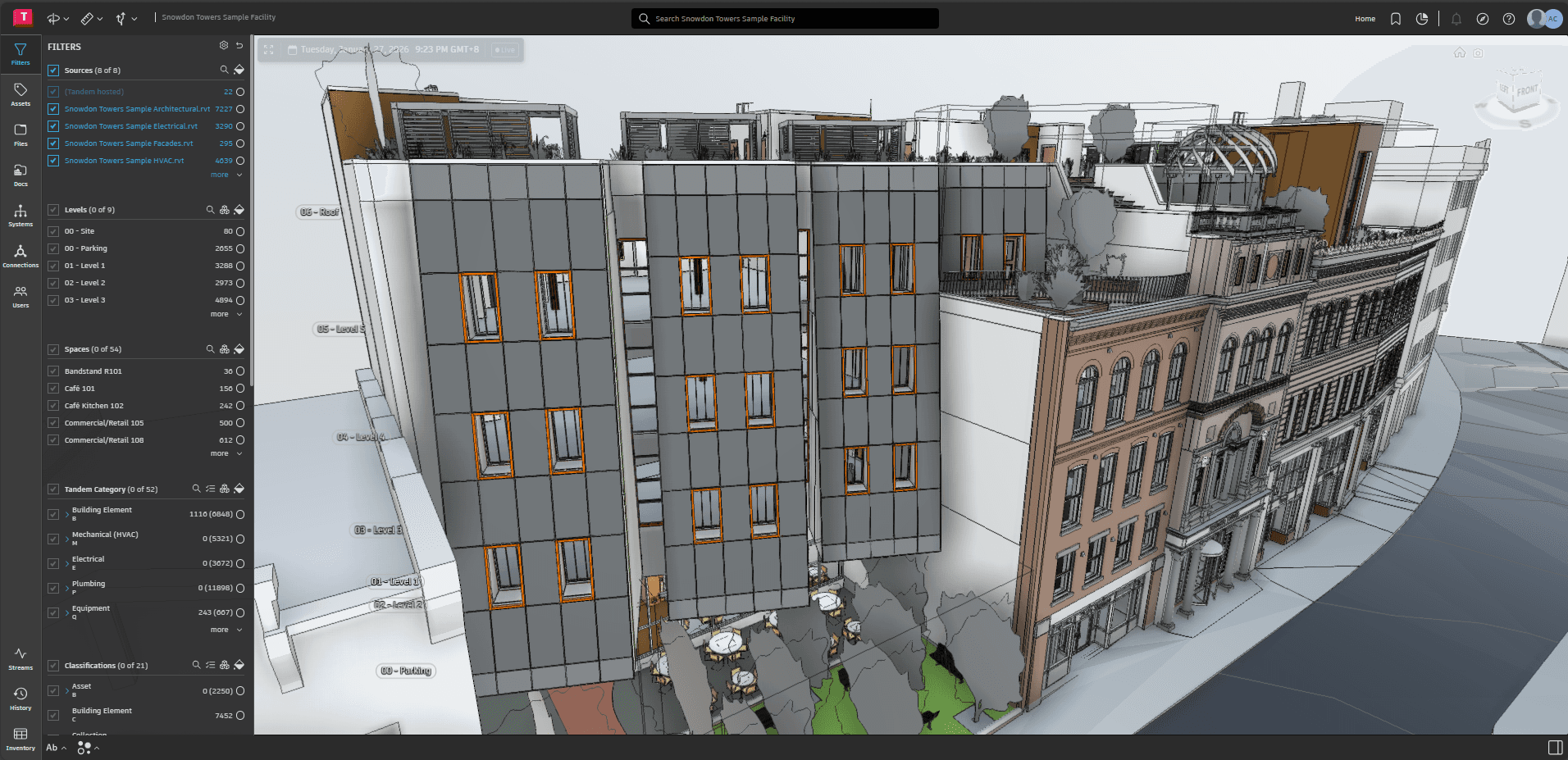
Autodesk Tandem: $3,540 USD per year, which includes three years of time-series data history. This is a solid choice for facilities with standard requirements and existing Autodesk infrastructure.
Cloud hosting: Tandem pricing doesn't include the cloud infrastructure needed to connect your physical sensors to the platform. Budget approximately $5,000 USD per year for IoT connectivity, data processing, and storage.
Enterprise solutions: For facilities with complex requirements, platforms like MRI Evolution offer more functionality but at higher cost. These typically start at $15,000-50,000+ annually depending on feature sets and building size.
Integration and configuration: Don't underestimate the effort required to set up data pipelines, configure dashboards, and integrate with existing facility management systems. Budget $15,000-40,000 for professional services to get everything properly configured.
Total initial investment: For a standard implementation using Tandem, expect $50,000-80,000. For complex facilities requiring enterprise solutions, costs can reach $150,000-300,000+.
Ongoing Operational Costs
Once your digital twin is operational, you'll have recurring expenses:
- Platform subscriptions: $3,540 USD/year (Tandem) or $15,000-50,000+/year for enterprise platforms
- Cloud infrastructure: $5,000 USD/year for IoT connectivity and data storage
- Software maintenance and updates: Typically included in platform subscriptions
- Staff training: Budget $5,000-15,000 for initial training, then ongoing skill development
- Data analytics services: Optional, but many organizations engage specialists to help interpret data and optimize operations ($10,000-30,000/year)
Annual ongoing costs: Minimum $8,000-10,000 USD/year for basic implementations, $30,000-80,000+/year for complex facilities.
When Standard Solutions Aren't Enough
It's important to understand that platforms like Autodesk Tandem, while powerful, have limitations. The three-year time-series history might not be sufficient for long-term trend analysis. Certain custom workflows or integrations with specialized facility management systems may not be supported out of the box.
If you're managing a large portfolio, need custom reporting dashboards, or have unique operational requirements, enterprise solutions like MRI Evolution or custom-built platforms may be more appropriate. These come with higher costs but offer greater flexibility and scalability.
The key is to honestly assess your requirements upfront. Starting with Tandem and discovering its limitations six months in can be expensive—both in terms of migration costs and lost productivity.
Cost Factors Specific to Singapore
Several factors will influence your final costs:
- Building size and complexity: A 10,000 sqft facility requires far fewer sensors and simpler integration than a 200,000 sqft campus
- Number of systems to integrate: HVAC alone is simpler than integrating HVAC, electrical, security, access control, and fire safety systems
- Level of automation desired: Basic monitoring is cheaper than fully automated controls that adjust systems based on occupancy and weather
- Integration with existing FM systems: If you need to connect with legacy building management systems, expect additional custom development costs
Implementation Timeline and Phases
Understanding the timeline is critical for planning and setting realistic expectations. Here's what a typical implementation looks like:
Phase 1: Planning and Assessment (2-4 weeks)
This initial phase involves assessing your current state and defining requirements. You'll need to:
- Inventory existing documentation and BIM models
- Assess building systems and determine what needs to be monitored
- Define business objectives and success metrics
- Evaluate platform options and integration requirements
- Develop a budget and secure approvals
Don't rush this phase. A thorough assessment saves time and money downstream.
Phase 2: BIM Model Development (4-12 weeks)
If you have existing BIM models, they'll need to be reviewed and enriched with asset data. If you're starting from scratch, this phase includes laser scanning and model development.
The timeline varies significantly based on building size and complexity. A 50,000 sqft facility with standard systems might take 6 weeks, while a 200,000 sqft complex facility could take 12+ weeks.
Working with experienced consultants during this phase ensures your model is properly structured for digital twin integration.
Phase 3: IoT Infrastructure (4-8 weeks)
This phase covers sensor specification, procurement, installation, and commissioning. Key activities include:
- Specifying sensor types and locations based on monitoring requirements
- Procuring hardware (sensors, gateways, network equipment)
- Installing and commissioning sensors
- Setting up network infrastructure and connectivity
- Testing to ensure reliable data transmission
Physical installation work can be disruptive, so coordinate carefully with building operations to minimize impact. It's also important to work with appointed contractors who understand the communication protocols (LoRaWAN, BACnet, Modbus, MQTT) and networking infrastructure supported by available IoT solutions. A contractor experienced with traditional electrical work but unfamiliar with IoT protocols may install sensors correctly from a physical standpoint but configure them in ways that prevent proper data transmission to your platform.
Phase 4: Platform Integration (6-10 weeks)
This is where everything comes together. You'll be:
- Setting up your chosen platform (Tandem, enterprise solution, or custom)
- Configuring data pipelines to ingest sensor data
- Developing dashboards and visualization interfaces
- Integrating with existing facility management systems
- Setting up alerts and automated workflows
This phase often takes longer than anticipated because it's where you ensure the analytical outputs meet the actual requirements of users. Facility managers need dashboards that answer specific operational questions—not just raw data displays. Engineers want alerts calibrated to meaningful thresholds, not false positives that get ignored. Finance teams need reports formatted for their existing workflows. This iterative refinement based on user feedback is what transforms a functioning system into a useful tool.
Professional BIM implementation support is valuable here, especially if your team lacks experience with these platforms.
Phase 5: Testing and Go-Live (2-4 weeks)
Before fully deploying, you'll need to:
- Conduct user acceptance testing with facility management staff
- Train all users on the platform and new workflows
- Develop documentation and standard operating procedures
- Run a parallel period where old and new systems operate simultaneously
- Execute a phased rollout, typically starting with one building or system
Total implementation timeline: Expect 4-9 months from initial planning to full operational deployment. Simple facilities with existing BIM models might complete in 4-5 months, while complex campuses requiring extensive custom integration could take 9-12 months.
Key Benefits and ROI
The business case for digital twins in Singapore is compelling, particularly when you factor in government mandates and operational realities.
Energy savings: Organizations typically see 15-30% reductions in energy consumption through optimized HVAC operation, lighting controls based on actual occupancy, and identification of energy waste. For a 100,000 sqft commercial building with $200,000 annual energy costs, this translates to $30,000-60,000/year in savings.
Maintenance cost reduction: Predictive maintenance enabled by digital twins can reduce maintenance costs by 20-40%. Instead of scheduled maintenance regardless of actual condition, you perform maintenance when data indicates it's actually needed. This reduces both parts costs and labor while extending equipment life.
Operational efficiency: Faster issue identification and resolution reduces downtime and improves occupant comfort. Facility managers report 30-50% reductions in time spent on reactive maintenance issues.
Compliance and reporting: Meeting BCA Green Mark requirements becomes significantly easier when you have continuous monitoring and automated reporting. This reduces the staff time required to compile sustainability reports and provides stronger documentation for audits.
Asset lifecycle extension: Better maintenance and operating conditions can extend equipment life by 10-20%, deferring significant capital expenses.
ROI timeline: For most facilities, the payback period is 2-3 years when you account for energy savings, maintenance reduction, and avoided capital expenses. Buildings with more intensive operations (data centers, hospitals, industrial facilities) often see faster returns.
For broader context on BIM benefits in construction and operations, see our article on BIM benefits in construction.
Common Use Cases in Singapore
Different facility types benefit in different ways from digital twin implementation:
Public housing and infrastructure (HDB): With one of the world's largest public housing portfolios, HDB faces unique challenges in facility management at scale. Digital twins enable centralized monitoring across entire estates, predictive maintenance planning, and data-driven decisions about upgrades and renovations.
Data centers: These facilities represent the most compelling use case for digital twins in Singapore. With strict uptime requirements (99.67%+ for Tier 1 centers), energy-intensive operations, and complex interdependencies between cooling, power, and IT systems, digital twins are becoming essential. Real-time monitoring of environmental conditions, predictive maintenance of critical equipment, and capacity planning all rely on the continuous data flow that digital twins provide. Learn more about BIM in data centers.
Healthcare facilities: Hospitals and clinics have stringent environmental requirements—operating rooms need 15-20 air changes per hour, pharmacy storage requires specific temperature ranges, and MRI facilities have unique HVAC needs. Digital twins automate the monitoring that would otherwise require constant manual checks, ensuring compliance and patient safety.
Commercial real estate: Office buildings, shopping centers, and mixed-use developments use digital twins to optimize energy consumption, improve tenant comfort, and demonstrate sustainability performance to increasingly ESG-conscious investors.
Industrial facilities: Manufacturing plants and logistics centers benefit from equipment monitoring, energy optimization, and space utilization tracking. Downtime costs are high in these facilities, making predictive maintenance particularly valuable.
For examples of how these technologies are being deployed, check out our portfolio of completed projects.
Choosing the Right Platform for Your Needs
Selecting the right digital twin platform is one of the most important decisions you'll make. Here's how to think about your options:
When Autodesk Tandem Works Well
Tandem is a solid choice for facilities with:
- Standard facility management requirements without extensive custom workflows
- Existing Autodesk ecosystem (Revit, BIM 360, Construction Cloud)
- Budget constraints that favor proven platforms over custom development
- 3-year time-series data sufficient for your analysis needs
- Standard integration requirements with common building systems
The $3,540 USD/year subscription plus ~$5,000 USD/year for cloud hosting represents the most cost-effective entry point for digital twins. For many facilities, this is entirely adequate.
When to Consider Enterprise Solutions
Move up to platforms like MRI Evolution or iTwin Experience when you have:
- Complex integration requirements with multiple specialized systems
- Custom workflow needs that standard platforms don't support
- Advanced reporting requirements for regulatory compliance or portfolio management
- Legacy system integration that requires custom connectors
- Long-term data retention beyond 3 years with advanced analytics
These solutions cost more—typically $15,000-50,000+ annually—but provide greater flexibility and functionality.
Custom Integration Scenarios
Some organizations require fully custom digital twin platforms when they have:
- Unique operational requirements not addressed by commercial platforms
- Multiple disparate systems that need sophisticated orchestration
- Specialized industry needs (e.g., semiconductor fabs, biotech facilities)
- Specific security or data sovereignty requirements
Custom platforms require significant upfront development investment ($100,000-500,000+) plus ongoing maintenance costs. Only pursue this path if your requirements truly demand it.
The right choice depends on your specific situation. Consider starting with a platform like Tandem for a pilot project. This allows you to validate the concept, understand your actual requirements, and make an informed decision about scaling—whether that means expanding Tandem deployment or moving to a more sophisticated solution.
Getting Started with Digital Twins
If you're ready to explore digital twin implementation, here's how to approach it:
Assess your starting point. Determine if you have existing BIM models or need scan to BIM services for accurate baseline assessment.
Define clear objectives. Identify specific problems to solve: energy reduction, facility management, compliance reporting, or ensuring equipment uptime.
Evaluate platform options. Start with Tandem ($3,540/year) for standard needs, or consider enterprise solutions like MRI Evolution or iTwin Experience for custom workflows. Factor in cloud hosting (~$5,000/year) and potential integration costs.
Start with a pilot. Test on one building or critical system to prove the concept and refine your approach before scaling.
Budget realistically. Expect $50,000+ initial setup and $8,000-10,000/year ongoing for basic implementations, or $150,000-300,000+ upfront and $30,000-80,000+/year for complex facilities.
Engage experienced consultants. Digital twin implementation requires expertise across BIM modeling, IoT infrastructure, and facility operations. Working with consultants who understand all domains reduces risk and accelerates deployment.
Contact us to discuss your requirements and develop a practical implementation plan.
Frequently Asked Questions

Related Articles
What Does a BIM Consultant Do for an Architect or Engineer in Singapore? (2025)
Full scope of a BIM consultant on architect and engineering consultant projects in Singapore — covering EIR authoring, Design Gateway CORENET X, clash coordination at design stage, and handover strategy.
What Does a BIM Consultant Do for a Main Contractor in Singapore? (2025)
Full scope of a BIM consultant on Singapore main contractor projects — covering BEP, clash detection, CORENET X, 4D/5D/6D BIM, and as-built handover.
BIM Manager vs Coordinator vs Modeller: What's the Difference?
BIM teams have three distinct roles: Manager, Coordinator, and Modeller, each with different responsibilities. Learn how to structure your team for successful digital delivery.